Veterans
Life After the Military Feels Empty. Here's What No One Tells You About Getting It Back.

If life after the military feels empty, you are not broken — you are disoriented. The structure, the mission, the brotherhood gave you a framework for identity that most civilians never have to build from scratch. When it's gone, the emptiness isn't weakness. It's the gap between who you were trained to be and who civilian life is asking you to become.
What You Left on the Base That No One Names
The military doesn't just give you a job. It gives you an identity. Your rank, your role, your unit — these aren't professional categories. They're the answer to “who are you?”
When that framework is gone, something that looks like emptiness moves in. But it isn't emptiness. It's the absence of structure that once held everything together. And civilian life has no equivalents.
Three things most veterans lose that no one names directly:
- Identity — rank, role, mission. Not just what you did. Who you were.
- Mission — a clarity of purpose that most civilians search for their entire lives and never find.
- Brotherhood — relationships forged under conditions most people never encounter and can't replicate.
One of the most common private thoughts among veterans in transition: I had more purpose at 22 than I do now. That's not self-pity. That's accurate. And naming it accurately is where the repair begins.
Why Civilian Life Never Quite Fits
The mismatch between military and civilian culture is structural, not personal. It's not that you failed to adapt. It's that the two cultures value different things in incompatible ways.
The things that made you exceptional in uniform — the competence, the precision, the willingness to subordinate comfort to mission — don't translate cleanly into office environments or suburban rhythms.
“Thank you for your service” is a social script, not a bridge. It acknowledges that something happened without having any capacity to understand what.
Moral Injury Is Not PTSD — and the Distinction Matters
PTSD is a physiological response. The body's alarm system stays stuck in the on position. It's real, it's documented, and it's treatable. If that's what you're experiencing, please reach out to a professional. This platform is not treatment for PTSD.
Moral injury is something different. It's what happens when someone witnesses, participates in, or fails to prevent something that violates their own moral code. It's the wound of a conscience that still works.
The private thought that many veterans carry but rarely say: I'm not sure I deserve a good life. That's not PTSD. That's moral injury. And it doesn't respond to the same interventions.
What moral injury often needs is not relief from a symptom — it needs integration into a story. A framework that holds the weight of what happened, acknowledges the moral complexity, and finds a way to carry it forward without being crushed by it.
The Mission Didn't End — It Changed
The question most veterans ask in transition: Who am I without the military?
That's the wrong question. The discipline, the leadership, the capacity to function under pressure, the willingness to put something larger than yourself first — none of that was the uniform. That was you. The uniform was just the context in which it was visible.
The better question: What mission is worth the same commitment I already know I'm capable of?
Some veterans find it in business. Some in advocacy. Some in family, in community, in service of a different kind. The form changes. The capacity doesn't retire from you.
Why Veterans' Stories Matter More Than They Know
The stories that aren't told don't disappear. They become the silence the next generation inherits.
A veteran who never speaks about what they carry passes that silence to their children — not as information, but as a shape. A withdrawal. A distance the children spend years trying to understand and can't.
You Don't Write It. You Tell It.
Rewrite Your Story is not a writing app. You never write a word. There's no blank page, no grammar, no “where do I start.”
You speak for 2–3 hours in a guided conversation with the Scribe — a calm, literary AI guide — moving through seven Passages that trace a life from origin through the dark chapter to the meaning that came after.
The Scribe asks questions most people have never been asked about their own lives. Not “what happened” — but “what did that mean?” Not “what did you do” — but “what do you understand now that you couldn't have understood then?”
Your audio is transcribed and immediately discarded — never stored. Everything autosaves. There's no deadline. Take it at your pace.
At the end: a 200–300 page hardcover memoir in your own voice, shaped as a Hero's Journey, delivered to your door.
You tell your story at night. You read it in the morning.
And with every purchase: a second full journey is given free — to another veteran, a woman starting over, or someone in recovery.
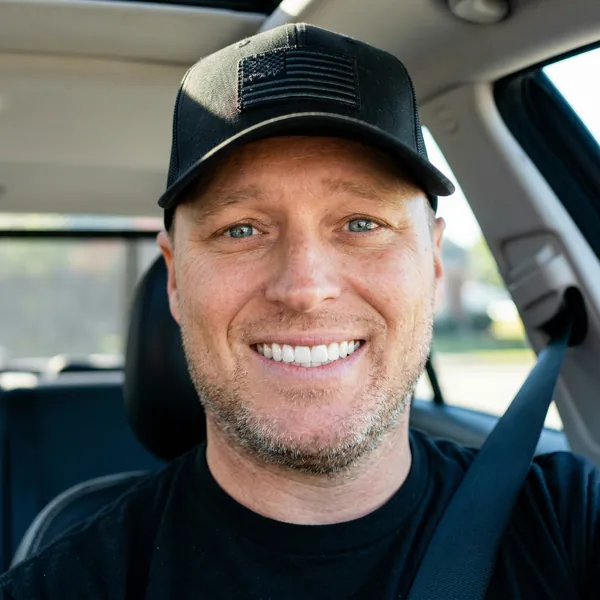
Brian Kiplinger is the founder of Rewrite Your Story — not a therapist, but someone who lived it and built the tool he wishes had existed. Why he built it →
If you’re in crisis, please reach out now: call or text 988 (Suicide & Crisis Lifeline, 24/7). Veterans: dial 988, then press 1, or text 838255. Rewrite Your Story is not therapy and is not a substitute for professional care.